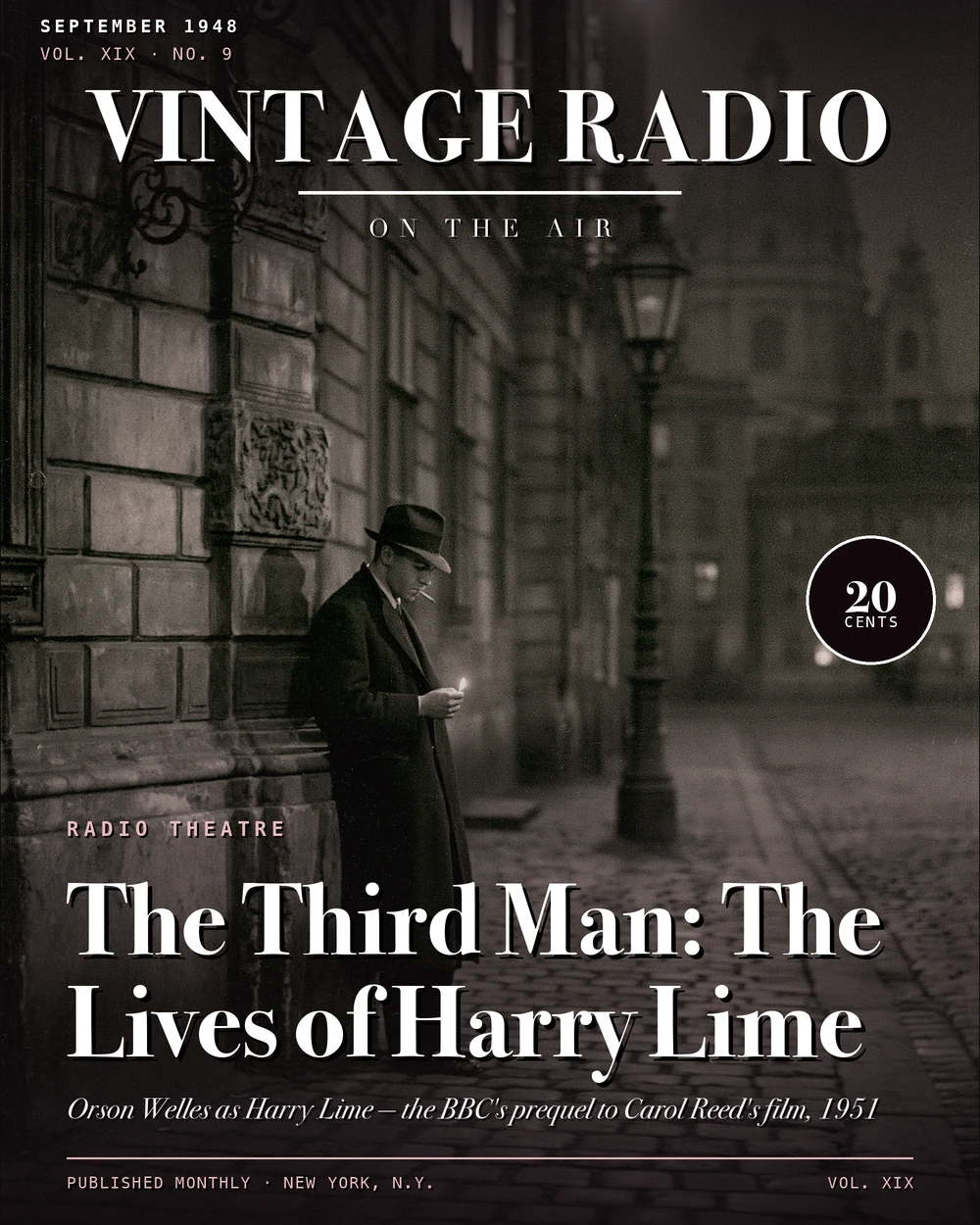
The Third Man: The Lives of Harry Lime
How a Small Part Became Its Own Series
Harry Lime barely survived long enough to matter in Graham Greene's original story or in Carol Reed's 1949 film adaptation. He was the mystery at the center of both — the absent friend, the shadowy figure glimpsed briefly before everything fell apart. But the character had something most supporting roles don't: a complete personality, vivid and slippery, suggested in just a handful of scenes. Producer Harry Alan Towers saw the potential in that personality and built an entire radio series around it.
Towers got there through a lucky piece of industry intelligence. He and Greene shared a literary agent, and through that connection he learned that when Greene sold The Third Man to producer Alexander Korda, he had held back the rights to the Harry Lime character specifically. Towers moved quickly, purchased those rights, and placed the series into production in 1951 under his company Towers of London. The result — 52 thirty-minute episodes — became one of that company's most successful productions.
Getting Orson Welles to play Lime took some persuading. Welles was living in London at the time and had already appeared in the film, so the character wasn't new to him — but he was primarily focused on filmmaking by 1951 and reportedly reluctant to commit to a radio series. Towers signed him anyway, and not just for this show: simultaneously, Welles was narrating Towers's Scotland Yard crime drama The Black Museum and playing Professor Moriarty in a Sherlock Holmes series starring John Gielgud and Ralph Richardson.
The Shape of the Series
The series is structured as a prequel to the film. Every episode opens with Anton Karas's zither theme playing for a moment before an echoing gunshot cuts it off, and then Welles speaks the show's signature monologue: "That was the shot that killed Harry Lime. He died in a sewer beneath Vienna, as those of you know who saw the movie The Third Man. Yes, that was the end of Harry Lime ... but it was not the beginning. Harry Lime had many lives ... and I can recount all of them. How do I know? Very simple. Because my name is Harry Lime." It's an elegant piece of framing — the audience already knows how the story ends, which frees the writers to roam wherever they like through whatever came before.
And they roamed widely. Each episode drops Lime into a different exotic locale — Paris, Rome, Venice, Tangiers, Naples, the French Riviera, Mexico, and assorted fictional corners of Europe and the Caribbean — with Lime adopting a different cover identity each time, sometimes a tourist, sometimes a reporter. The tone is considerably lighter than the film. The Lime of the radio series is less a criminal mastermind than a bumbling, comedic scoundrel — a con artist who charms ladies out of their jewelry, breaks and enters, and exploits the gullible, but who draws a firm line at murder and blackmail. His victims tend to be portrayed as greedier than he is, which keeps the whole enterprise from feeling too dark. He stole from the rich and gave to the poor, with Harry Lime himself usually being the poorest recipient.
The first 16 episodes aired on the BBC Light Programme between August 3, 1951, and November 16, 1951, making this the first independently produced dramatic series ever broadcast by the BBC. The full 52-episode run concluded on July 25, 1952, and was then syndicated to American radio stations under the slightly retitled name The Lives of Harry Lime — the British original had been called The Adventures of Harry Lime. Episodes were produced at IBC Studios in London and directed by Towers, Welles, and Tig Roe.
The Writing Question
The question of who actually wrote these episodes is thornier than the credits suggest. Towers has said that the series was initially written by a team of experienced American radio scriptwriters paid $1,000 per script. When Welles found out what they were earning, he offered to write six scripts himself, collected $6,000, and then a ghostwriter showed up at Towers's office demanding payment. When Towers told Welles, Welles reportedly said: "Don't pay him. They weren't very good scripts."
The writing credits for the 1952 short story collection — fifteen of the episodes adapted into prose and published in the United Kingdom as Pocket Books B77, credited to "Orson Welles and others" — give a clearer picture of how many hands were involved. The team included Sigmund Miller, Robert Cenedella, Joseph Cochran, Carl Jampel, Jonquil Anthony, Virginia Cooke, Peter Lyon, Bud Lesser, and Irvan Ashkinazy, among others. That collection was never published in the United States and has never been reprinted, making surviving copies genuinely scarce.
Film Comment has noted that the series' mix of human idiosyncrasy and political comedy foreshadowed The Goon Show, which later made direct references to Harry Lime and used the zither theme in an episode titled "Foiled by President Fred." Whether that influence was intentional or just the result of a shared cultural moment is harder to say.
Where the Episodes Went Next
The most significant afterlife of the radio scripts belongs to Welles himself. The episode "Man of Mystery," credited to Welles as writer, was later expanded and became the basis for his 1955 film Mr. Arkadin. Two other episodes, "Murder on the Riviera" and "Blackmail Is a Nasty Word," also contributed plot elements to that film. Welles had initially attempted to convert one episode script into a film for producer Alexander Korda, but when that project fell through, the story was adapted into a French novel, Une Grosse Légume, published by Gallimard in 1953 under Welles's name but ghostwritten by Maurice Bessy. The book has never appeared in English — though in 2018, author Matthew Asprey Gear discovered an English-language typescript of it in Turin, bound and credited to Welles.
One episode, "Horse Play," runs a con scheme that closely resembles the central plot of the 1973 film The Sting; both draw on David W. Maurer's 1940 book The Big Con. Harry Lime also crossed into comics during the run, appearing in two stories in the fourth issue of the British Super Detective Library: "The Secret of the Circus" and "Too Many Crooks."
The connection between the radio series and Mr. Arkadin is examined in detail in a 2010 scholarly article — "Orson Welles, Harry Alan Towers, and the Many Lives of Harry Lime," published in Journal of Radio & Audio Media, Vol. 17, No. 2 — drawn partly from a 2008 interview with Towers. That article describes the series as the only radio show on which Welles played a recurring dramatic role. A 1976 doctoral dissertation at the University of Texas at Austin, by F. Tavares, offered a critical analysis of selected dramatic elements across the series, and Michigan professor Robert Kroll later published an 84-page study guide summarizing all 52 episodes with broadcast dates, writing credits, and notable quotes.
The Zither and What It Carried
Any discussion of this series has to account for the zither. Anton Karas wrote "The Third Man Theme" and performed it throughout both the film and the radio series. Carol Reed had discovered Karas playing in a Vienna bistro and hired him on the spot. The theme became a worldwide phenomenon after the film's release — Karas grew rich on the royalties — and it gave the radio series an immediate sonic identity. Every episode opened with it, and the abrupt gunshot that cut it off became one of the more inventive audio signatures in the medium.
The zither is what you hear first and what lingers. Commentary on the series tends to agree that the music gives the show a texture its plots don't always earn on their own. A recording of the episode "A Ticket to Tangiers" appears on the Criterion Collection DVD edition of The Third Man, and three episodes — "Man of Mystery," "Murder on the Riviera," and "Blackmail Is a Nasty Word" — are included on Criterion's The Complete Mr. Arkadin, which gives some sense of how the radio series has been evaluated in relation to Welles's film work.
After the Radio Run
A television series called The Third Man ran from January 23, 1959, to August 27, 1965, producing 77 thirty-minute black-and-white episodes. Michael Rennie played Harry Lime, with Jonathan Harris as his assistant Bradford Webster, in a co-production between the BBC, National Telefilm Associates, and Prestige Productions — the last of which was owned by Rennie himself. The television version transformed Lime from a con artist into a debonair international art dealer and private investigator, which is a substantial change in character. The first 20 episodes were filmed at 20th Century-Fox Studios in the United States; later episodes moved to Shepperton Studios and Associated-British Elstree Studios in England.
The radio series itself is complete: all 52 produced episodes survive on tape. For years, early sources — including critic Peter Noble and French critics André Bazin and Jacques Doniol-Vacroze writing in Cahiers du Cinéma in September 1958 — reported the total as only 39 episodes, an error that circulated widely before the actual count was established. The discrepancy between the BBC's 16-episode broadcast run and the full 52-episode syndicated series likely contributed to the confusion. Welles undertook the project partly to raise funds for his own filmmaking, which gives the whole run a slightly provisional quality — but the 52 episodes exist, they're complete, and they document the only radio series in which Welles played a recurring dramatic role across a full season.